
Main takeaway
Consumers are becoming more selective as economic pressure builds, creating a widening gap between brands that deliver a compelling value equation and those that do not.
Consumer snapshot
- Inflation: Prices are rising faster than wages for the first time in three years (NBC News)
- Jobs: Grew by 150,000 in April, with gains in the private sector and declines in the public sector (Yahoo Finance)
- Housing: Spring home sales are falling short of expectations as inflation pushes mortgage rates higher (The Wall Street Journal)
- Sentiment: Financial confidence continues to diverge between stockholders and non-stockholders (CNBC)
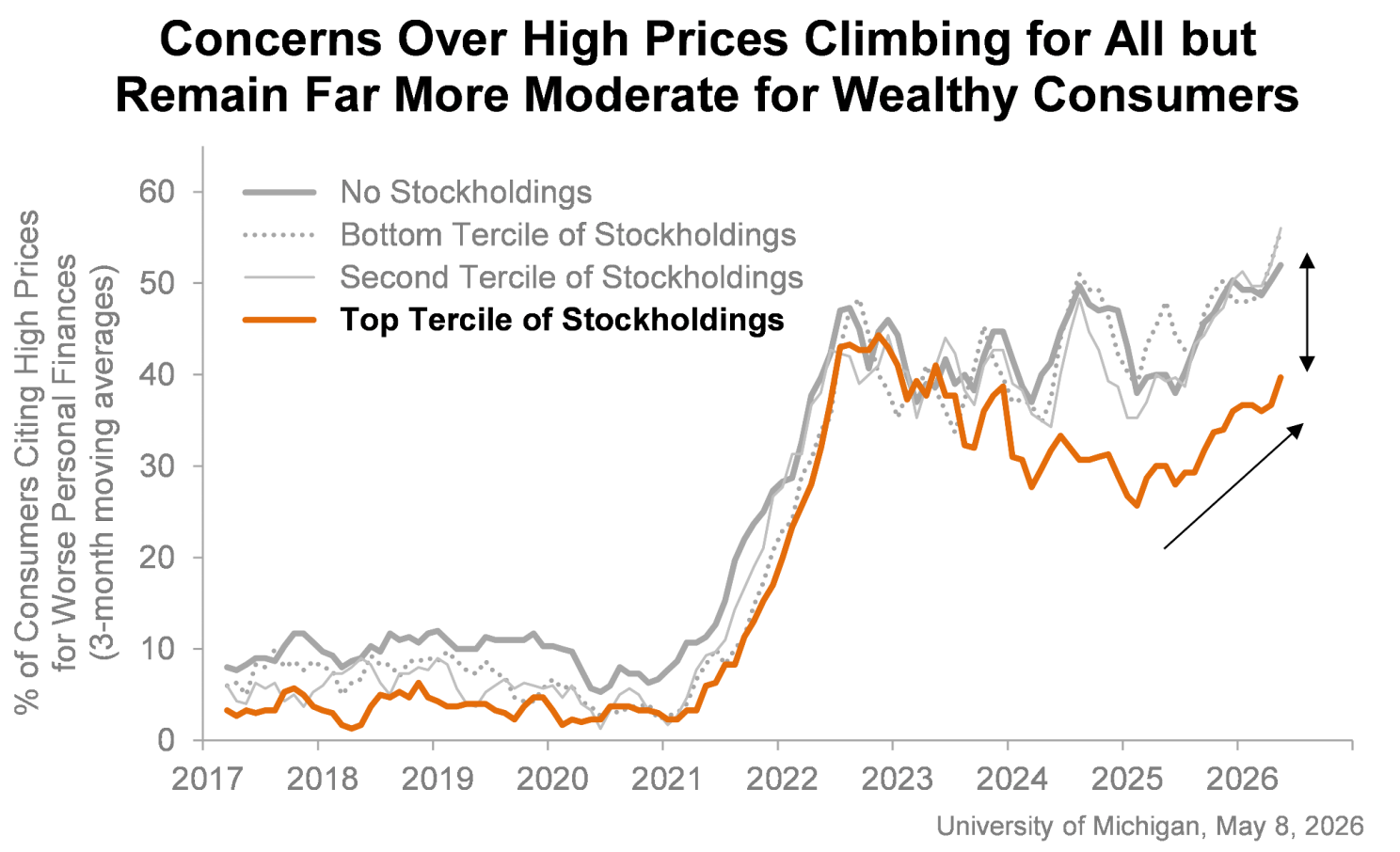
Quantiiv's take: Inflation is impacting all consumers, but the gap between higher- and lower-income households continues to widen. Restaurants must recognize this divergence when designing traffic-driving strategies.
Industry news and earnings
- Industry: QSR net sales grew 2.3% in April despite traffic declining 0.8% year over year (Revenue Management Solutions)
- McDonald's: Q1 results exceeded expectations, but management warned that inflationary pressure on lower-income consumers could weigh on Q2 sales (CNBC)
- RBI: Results were mixed, with Burger King (+5.8%) and Tim Hortons (+1.6%) posting growth while Popeyes declined 6.5% (Restaurant Brands International)
- Domino's and Chipotle: Both reported modest positive same-store sales but noted softer demand late in the quarter amid economic uncertainty (CNBC)
Quantiiv's take: The industry continued to grow, but the underlying traffic picture remains fragile as economic uncertainty weighed on demand late in the quarter. Brands that stay focused on long-term performance will emerge stronger from a challenging macro environment.
This caught my eye: Will wobbled consumers still DoorDash?
Third-party delivery is the most expensive channel in the restaurant industry, capitalizing on the value of convenience. As economic uncertainty wobbles the consumer, one might expect these occasions to decline as customers trade into more economical alternatives.
DoorDash's earnings suggest the exact opposite.
In a strong quarter, DoorDash grew revenue 33% to more than $4 billion. Most notably, U.S. restaurants, the company's most mature business, continued to grow, driven by both new customer acquisition and higher order frequency from existing customers.
The implication is clear: while consumers are becoming more selective, they are not eliminating spending. They continue to spend on occasions where the value equation remains compelling, and convenience has become an increasingly important part of that equation.
As DoorDash expands into grocery, retail, and other local commerce categories, its ability to acquire and deepen customer relationships will continue to strengthen, especially within the DashPass program. Restaurants are no longer competing solely against other restaurants; they are increasingly competing against platforms that also want to own the customer relationship.
Quantiiv's take: Economic pressure is forcing consumers to be more selective, not to stop spending altogether. Restaurants must increase their value equation to win traffic and ultimately own the customer relationship.